
An Infrastructure for Info
We talked to Eric Paton,
a technical specialist at Ford, about the intricacies of CAN. Paton
says, "If there's one thing drivers should know when getting into a car,
it's that everything seems simple, but beneath the covers it's
incredibly complex." The design of CAN is similar to that of a freeway
system. Data move like vehicles from high-traffic highways to local
roads via on and off ramps. Thousands of data points traverse this
freeway at any time along any given stretch and can get off at any exit.
Throughout the car are various computers called electronic control
units, or ECUs—the traffic lights and intersections of our road-system
analogy. Each ECU has several jobs: controlling the engine or
transmission, rolling up windows, unlocking doors, and the like. These
computers have sensors and switches wired in to detect variables such as
temperature, pressure, voltage, acceleration at different angles,
braking, yaw and roll of the vehicle, steering angle, and many other
signals. When an ECU needs a signal from a sensor connected to an ECU
elsewhere in the car, that's where CAN comes in.
Like
a freeway, the CANbus network allows data from all the sensors and
computers to circulate around the car at all times. Each computer
transmits all its sensor and programming information constantly—as many
as 2000 signals are floating around the network at any time, whether
they're being requested or not. At the same time, each ECU "listens" to
the network to pluck out pieces of information it may need to carry out
its work. There is no central hub or routing system, just a continuous
flow of information that's always available to the ECUs.
Take,
for instance, power sliding doors, a common feature on modern minivans.
These doors are operated by an ECU called the body control module.
Sensors constantly report whether the door is open or closed, and when
the driver pushes a button to close the door, the signal from that
switch is broadcast across the network. When the ECU gets that signal,
however, it doesn't simply close the door. First, it checks the data
stream to make sure the car is in park and not moving. If all is well,
it then gives a command to a power circuit that energizes the motors
used to close the door. It goes even further, though—the ECU then
monitors the voltage consumed by the motors. If it detects a voltage
spike, which happens when a door is hindered by an errant handbag or a
wayward body part, the ECU immediately reverses the direction of the
door to prevent potential injury. If the door closes properly, the latch
electrically locks the door shut. In the old days, this would have been
an engineering feat. Just electrically powering the doors would have
required dedicated wires running between the shifter, the door switch,
and the motor.
Before
CAN was developed in the mid-'80s, every time an automaker added an
electronic feature, like, say, heated seats, new, dedicated wires had to
be added just to connect the heaters to a dash-mounted switch. Over the
years, more features meant more wires, until there were literally miles
of wire in wrist-thick vines snaking all over the car. With CAN, the
seat heaters and the switch that powers them don't have to be directly
wired together. They can simply "talk" over the existing CAN network—no
special wires needed. What is needed, however, is some additional
programming to get all the devices networked. It's a choice to shift
toward programming complexity over physical complexity. CAN has made
software development more challenging, but it has had many more positive
effects: significant cost savings to the consumer, much lighter weight,
reduced reliance on rubber and copper resources, and far better
reliability with fewer wires to break over time. Those attributes may be
important from a technical standpoint, but the most profound effect of
this shift toward programming is on vehicle diagnostics and software
updates.
Advertisement - Continue Reading Below
Car, Heal Thyself
The shrinking of the car's wiring harness
and other benefits were not the main impetus for the creation of CAN.
As pollution requirements matured in the late 1970s, the National
Highway Traffic Safety Administration and the California Air Resources
Board demanded ways to monitor the effectiveness of
vehicle-emissions-control systems. The result of that directive was the
standardized On-Board Diagnostics protocol (now in its second
generation, known as OBD-II) that required a CAN network to efficiently
connect to all the engine sensors for a self-diagnosis. With this
interconnection, a designated ECU can watch the network for problem
reports broadcast to the network as OBD-II codes. If an ECU detects a
problem, it broadcasts it as an alphanumeric code and the Check Engine
light is turned on. Modern cars carry out these self-checks any time the
car is running. Anyone with a handheld code reader can plug into the standard 16-pin data port in the driver footwell and
retrieve fault codes. An Internet search will usually explain the fault
or at least give a hint at the problem.
That
same data port also comes in handy if a manufacturer uncovers a
computer glitch or wants to modify how the car operates. For example, a
carmaker may develop an algorithm for smoother transmission shifts.
Installing it in any customer car is as simple as a dealer technician
plugging his computer into the data port and uploading the new software.
Before CAN, this would've meant physically replacing an ECU.
Peeking Behind the Digital Curtain
The heavy tinkerers out there
know all about the ability to reprogram, or hack, a car. Manufacturers
frown on the practice, of course—it will void your warranty—but not
everyone can resist the urge to reverse-engineer code and make a few
changes. Unless you're sporting a computer-engineering degree, hacking
into the system directly is inadvisable (if you accidentally grenade
your engine, you'll be left with a car-shaped driveway ornament),
although some aftermarket products make interacting with your car's
network quite rewarding, especially if you're a speed freak. Mechanics
in hot-rod shops, who modify engines for more horsepower, have been
successfully reprogramming cars for at least a decade. But, remember,
they're professionals.
WHAT'S NEXT: Wired Like the Web
Your
car's electronics network may be sophisticated, but as the amount of
data it handles increases over time, it will have to be upgraded. Most
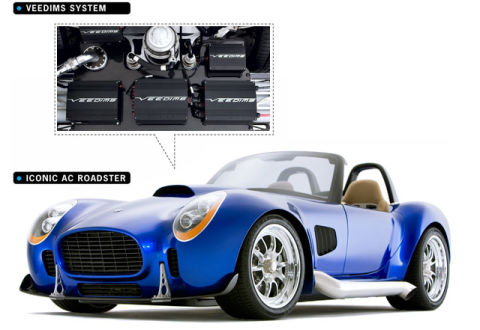
likely, cars will adopt an Ethernet-based system such as VEEDIMS, the
one in the high-tech Iconic AC Roadster. VEEDIMS assigns each vehicle
component an IP address so that centralized and remote computers can
pass around huge amounts of information. Attach a cellular connection
and data can be beamed to the cloud for analysis. Dealer visits for
software upgrades could be replaced by a download. What's holding all
this back? Legacy costs. It would take billions to re-create the
software. But car Ethernet is coming someday.
0 comments:
Post a Comment