
Your
elderly car has required little in the way of episodic repair, for
which you're glad. But at your last scheduled maintenance, the service
manager advised you that you would need to replace the brake pads, front
and rear, before too long. But deferring that expense for a while
wouldn't be a problem, he said.
And
all was fine for a couple of months, until you noticed the brake pedal
dipping a little too close to the carpet while sitting at traffic
lights. Not a big problem. Replacing the pads yourself on a Saturday
morning should do the trick.
Except that now, despite the new pads all around, the brake pedal still feels spongy and low. You need to bleed your brakes.
Air-Cooled
Here's
what happened. The pads wore so thin that the brake fluid level dropped
too low in the master cylinder reservoir. An air bubble or three got
pumped into the lines. And because air is compressible, you now have the
equivalent of a very soft spring in the solid column of brake fluid
between your foot and the wheels. Bleeding the brakes will flush that
air out.
The job also
involves replacing the old fluid with fresh, which is a good thing. Why
would the fluid need to be replaced? It becomes contaminated with
atmospheric dirt and abrasive metal wear particles from moving parts in
the master cylinder and calipers. It absorbs moisture from the air,
which can lower the boiling point of the fluid enough to make it boil at
the end of a long downhill grade. (And steam, like air, is
compressible.) High temperatures from those high-energy-dissipation
stops can degrade the alcohol-based fluid itself. Eventually, your
water-clear brake fluid starts to look more like squid ink.
Antilock
braking systems are even less tolerant of contaminated fluid and air
than non-ABS. The ABS hydraulic pump operates at several thousand psi,
forcing brake fluid through very small valves. This can whip air and
brake fluid into something like the foam on a latte, which makes
bleeding difficult. Those same valves and pump can easily be damaged by
tiny abrasive particles.
The
good news: Air that has entered the ABS controller can be bled out. Bad
news: Some vehicles require the use of a hideously expensive
proprietary ABS scan tool to cycle the pump and valves to purge the last
of the air. But there's a simple solution to that: Never let any air
enter the system. You can flush a system with fresh fluid by using
nothing more than a wrench that fits the bleeder bolts -- and a helper
with a normal attention span.
Let It Bleed
To
properly bleed the brakes, start with a couple of 8-ounce cans of fresh
brake fluid. An unopened can has a long shelf life. An opened can
should be discarded within a few weeks. Get the vehicle up in the air
and remove all four wheels. Well, okay, you might be able to do this
with the wheels on if you can swing a wrench on the bleeder valves.
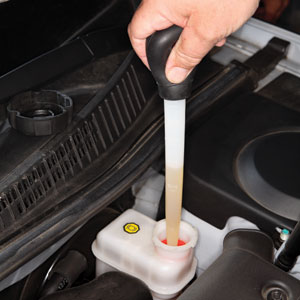 | 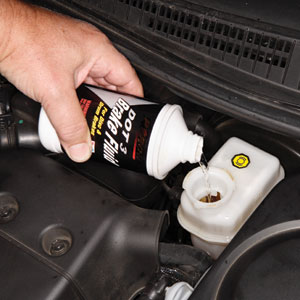 |
| Suck the old fluid and sediment out of the master cylinder reservoir with a turkey baster or syringe. | Top off the reservoir with fresh fluid regularly as you bleed the system. Don't let it get more than half empty. |
So,
your next task is to make sure the bleeder valves can be loosened.
You'll need a box wrench that fits the bleeder bolt. A crescent wrench
or Vise-Grip probably will just round off the bolt's flats. A little
penetrating oil drizzled on the bolts the day before will help. So will
some judicious tapping with a hammer to break up any corrosion. Loosen
the bolts, but leave them closed.
Advertisement - Continue Reading Below
If
you can't turn the bleeders without breaking them off, you'll need to
replace the brake calipers or wheel cylinders. See the above notation
about penetrating oil and light hammer taps before applying enough
torque to break these minuscule, hollow bolts.
Sneak
into the kitchen and appropriate the small turkey baster. Remove the
top to the master cylinder reservoir and suck out as much of the old
squid ink as you can. Clean any sediment out of the reservoir with a
clean, lint-free rag. Do not spill any brake fluid on any painted
surfaces -- it will remove the paint pretty much immediately.
Get
a piece of clear plastic tubing (aquarium tubing is fine, and it's
cheap). Push one end of the tube over the brake bleeder bolt at the
right rear of the car. Put the other end of the tube into a small, clear
bottle with an inch or two of clean brake fluid in it. (This will keep
air from being sucked back into the brake cylinder or caliper.) Put a
piece of 1 x 4 lumber or some other spacer under the pedal to prevent
the pedal from traveling too far when line pressure is released. Top off
the master cylinder reservoir with fresh fluid and put the cover back
on the reservoir. Fluid will squirt out of an open reservoir every time
the pedal is released.
Cue the Helper
Your
helper needs to be someone who can follow instructions exactly. He or
she won't get dirty hands so you don't need to pull one of your pals
away from the ballgame. A teenager in a white dress will do fine. Have
your helper sit in the driver's seat and await your orders. Here's the
drill: You say "down." He or she depresses the brake pedal with about
the same amount of force needed to keep the car from rolling forward at a
traffic light. Then your helper says "down" and keeps the pressure on.
When you hear the call, warn your helper that the brake pedal is about
to sink underfoot and to keep the pressure on constantly. Then crack the
bleeder bolt a quarter-turn.
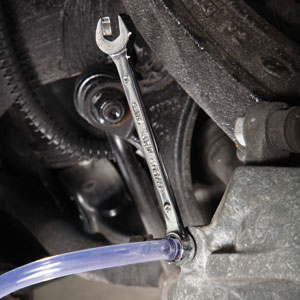 | 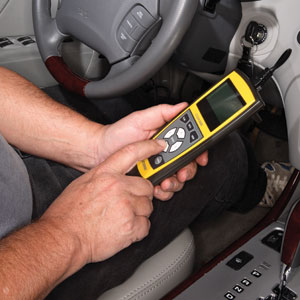 |
| A bleeder bolt can become difficult to remove. Use a proper-fitting box wrench to keep from rounding it off. | Got ABS? You may need to use a scan tool during the bleeding process to cycle the pump and valves. |
Some
of the old, contaminated fluid will trickle down the tubing into your
bottle. When the trickle stops, close the bleeder. Then you say "up."
Your helper says "up," and removes his or her foot from the pedal.
Repeat
this process until fresh, clear fluid comes from the bleeder. Any
out-of-sequence moves can suck air into the caliper. Yes, the end of the
tubing is submerged in fluid, but air can travel past the threads on
the bleeder bolt into the caliper if there's ever any negative pressure
in the system while the bleeder is cracked.
Every
half-dozen or so iterations, top off the reservoir with fresh fluid. Do
not allow the reservoir to get more than half empty -- air can be
sucked into the master cylinder unless the fluid level remains well
above the bottom of the reservoir that feeds the cylinder.
Once
clean fluid is coming out of the brake, snug the bleeder bolt and move
your operation to the left rear wheel and start all over again. Next
repeat the process with the right front and finally with the left front.
Follow that with a few strokes of fresh fluid from all four, again.
Don't forget to keep the reservoir topped off.
Air Breather
For
an older vehicle without an antilock braking system, this process will
do a great job even if you have air in the system, say, after replacing a
caliper or master cylinder. For advice on bleeding ABS, you'll need to
consult your service manual. There may be a bleeder bolt right on the
ABS controller, or you may need to beg, borrow or steal an ABS-capable
scan tool.
0 comments:
Post a Comment